
Danville City Directory Holdings
Danville Public Library and linked Illinois repositories preserve overlapping materials rather than one uniform digital set. The city directory run begins in 1874 according to the library and Illinois Archives repository description. Exact publisher changes and missing individual years are not published as one master list, so confirm a desired year with the catalog or Archives Room.
| Collection | Years | Where held | Access |
|---|---|---|---|
| Danville city directories | 1874-present library description | Danville Public Library Archives | In-library, non-circulating; remote request |
| R.L. Polk directory | 1909; related editions include 1899, 1906, 1913 | Library shelf and Google Books record | Preview online; verify full pages locally |
| Danville criss-cross books | 1980-1996 | Library of Congress inventory | Address-first research; request guidance online |
| Sanborn maps | 1884-1970 | Danville Public Library Archives | In-library archive use |
| Local newspapers | 1833-present library claim | DPL, University of Illinois, microfilm | Mixed digital and in-library access |
The collection table shows coverage claims, not proof that every volume or issue survives. Save the year and format used. A printed book, OCR preview, microfilm image, and catalog description provide different levels of evidence.
Visit Danville’s Directory Archive
The Danville Public Library Archives Room is on the second floor at 319 N. Vermilion Street. The non-circulating collection is used in the library. Reference and Archives staff can be reached at 217-477-5228 or Reference_Desk@danvillepubliclibrary.org. Posted main-library hours were Monday through Thursday, 8 a.m. to 7 p.m., and Friday and Saturday, 8 a.m. to 4 p.m.; verify hours before visiting.
Brief remote questions may be answered. A genealogy request taking more than 30 minutes costs $10 and includes up to three photocopies and postage. Extra copies are 25 cents. The archive also lists black-and-white, color, and large-page copy charges. A good request names the person, approximate year, known address, spelling variants, and the exact volumes or source types to check.
Archive tip. Ask for one surname in a short span of directory years. A narrow request is easier to price and preserves the date of each result.
Inside Danville’s 1909 Polk
The 1909 R.L. Polk & Company bibliographic record identifies the University of Illinois Urbana-Champaign original. Its visible contents include City Government on page 5, a business directory on page 12, and a Danville Street Number Guide on page 23. Related Google Books editions visibly include 1899, 1906, and 1913, but those references do not establish a complete year-by-year publisher run.
OCR terms include occupation abbreviations such as bkkpr, blksmith, carp, miner, propr, retired, and wks. They reflect Danville’s coal, rail, trade, and industrial record trail. Search them as clues, then inspect the printed page. OCR can split names, misread initials, and detach an address from the right line.
| 1874 | Start of the library’s stated Danville directory run |
|---|---|
| 1909 | R.L. Polk volume with government, business, and street-number sections |
| 1980-1996 | Danville criss-cross inventory identified by the Library of Congress |
| Present | End point in the library’s broad holdings description, subject to shelf verification |
Read a Danville Directory Entry
Begin with the name, initials, occupation, and residence line actually visible in the selected volume. A complete individual entry was not exposed in the public 1909 preview, so spouse-in-parentheses, employer, widow, and owner or renter marks must be verified on the page before they are reported as Danville fields. Photograph or transcribe the abbreviation key first. That prevents a short code from becoming an unsupported claim.
| Name and initials | Record the printed order, spelling, and middle initial |
|---|---|
| Occupation code | Expand it only with the volume’s own key |
| Street address | Keep direction, number, and suffix exactly as printed |
| Household notation | Transcribe spouse, widow, boarder, or ownership marks only if shown |
| Nearby entries | Save adjacent names when address order supplies useful context |
- Criss-cross directory
- An address-first book organized by street and house number.
- Householder index
- A list centered on the person identified as the household head, subject to the publisher’s rules.
- Abbreviation key
- The volume’s legend for shortened trades, residence terms, and other marks.
Reverse Danville Directory Years
A name-first city directory works when the surname is known. A criss-cross book reverses the search for a known house number. The Library of Congress Danville inventory covers 1980 through 1996. Record the occupant or business exactly as printed and compare the next available year. Never assume the listed occupant owned the parcel.
The Library of Congress guidance appears in the captured image below.
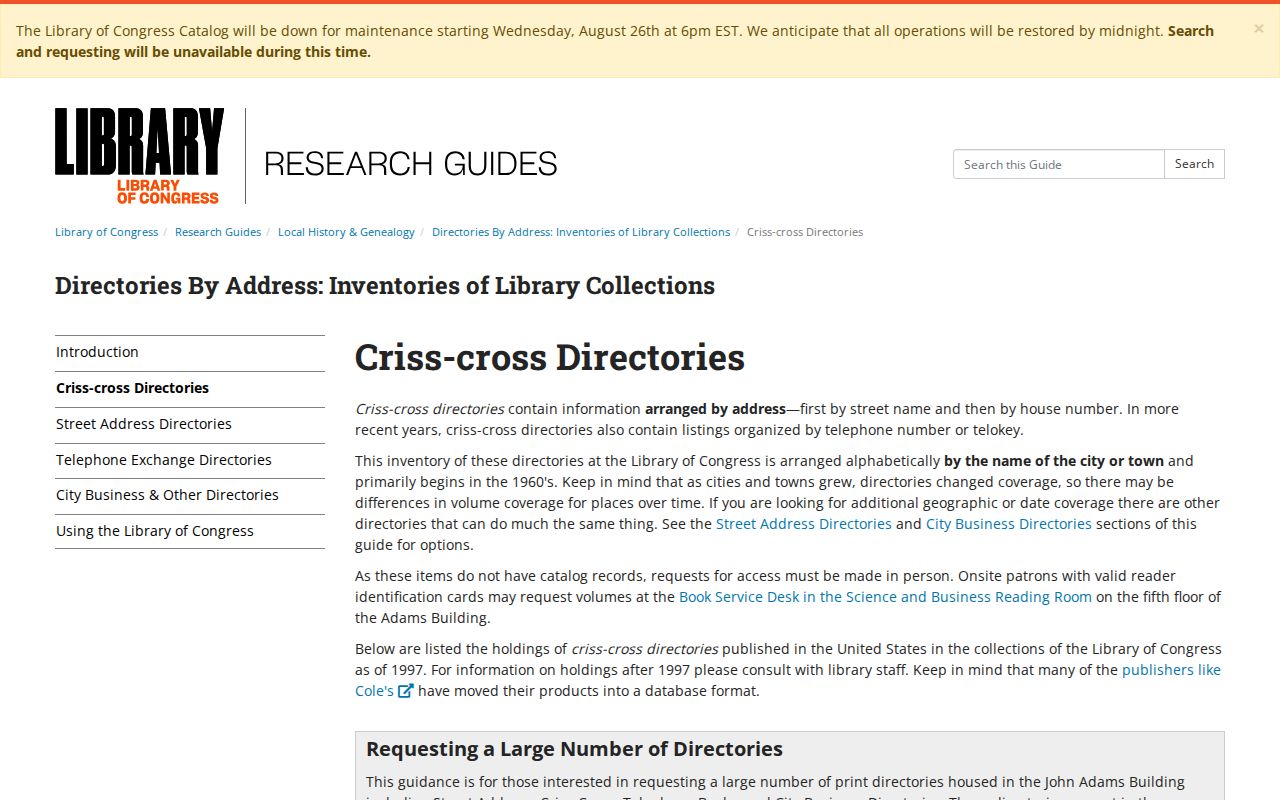
The source explains why address-first volumes complement, rather than replace, the surname order of older Danville city directories.
Add Danville Newspapers and Pape
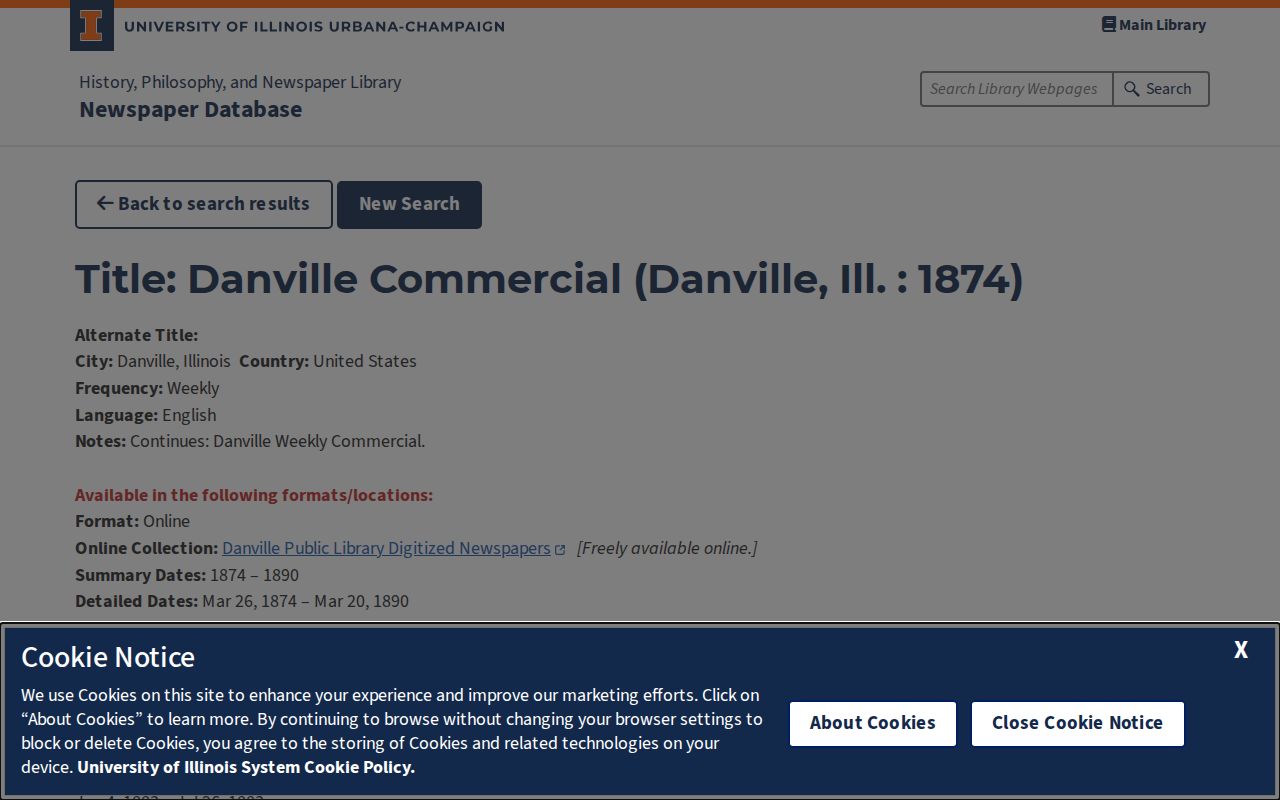
Directory evidence becomes stronger when another dated source confirms it. The University of Illinois provides a digitized Danville Commercial holding for 1874-1890. Danville Daily News holdings cover digitized dates from 1876 through 1902 with gaps. DPL reports newspaper holdings from 1833 forward, Commercial-News microfilm for 1980-2012, and an e-edition from 2013.
The captured university holdings page gives the access point for the Commercial run.
A newspaper search can connect a directory name to an obituary, legal notice, social note, advertisement, or street. Search initials, maiden names, nearby towns, cemetery, and occupation. DPL’s Pape Mortuary Database advertises more than 275,000 records. It is a funeral-home lead, not a death certificate, so verify a result against the newspaper, cemetery, or County Clerk record.
Trace Family in Danville Directories
Use each directory as a dated snapshot. Follow the same Danville surname through adjacent years, record every address and printed trade, and note the first and last appearances. Federal census records then supply household detail at released census intervals. The latest public federal census is 1950 under the 72-year rule. DPL’s own descriptions disagree on the final census year held, so verify the shelf or database rather than repeating a broad range as complete.
- Find the earliest likely surname entry and copy its full line plus the volume year.
- Check the prior and next available books, noting moves, new initials, and changed occupations.
- Use the Street Number Guide or a criss-cross volume to test the address from the other direction.
- Pair released census years with the nearest directories and compare household names.
- Close a disappearance with newspapers, Pape, probate, cemetery, or vital-record evidence.
Disappearance does not by itself mean death. The person may have moved, been omitted, changed a surname, entered an institution, or chosen an unlisted number. The Illiana Genealogical & Historical Society collections add cemetery books and Vermilion probate files from about 1829 through 1970. The society is volunteer-run and offers research at a stated reasonable cost.
Map Old Danville Addresses
Danville’s archive holds Sanborn fire-insurance maps from 1884 through 1970. These sheets show building footprints, uses, street numbers, and nearby structures, not a resident list. Compare a directory address to the map for the same period, then carry the lot or place forward into a current parcel map. The 1909 Street Number Guide gives another dated bridge when a house number appears to have changed.
No official citywide renumbering chronology was located. Test changes with two adjacent directory years, nearby house numbers, Sanborn sheets, and the Recorder’s legal description. For modern owner or parcel work, use the Danville street directory workflow instead of treating an old occupant as the current owner.
Danville’s archive reflects the city’s salt, coal, rail, manufacturing, veterans, education, and health history. A printed occupation can point toward a newspaper, institutional file, veterans collection, or vertical file. It remains a dated historical clue, not a statement about the person today.